
Legacy Gift Supports Sensory-Inclusive Care
While hospitals provide life-saving care, hope, and healing – they are also very busy places, bustling with sounds, bright lights, and unfamiliar environments that can be challenging for patients with sensory needs. Individuals with autism, PTSD (posttraumatic stress disorder), dementia, anxiety, stroke, or other conditions often find the hospital environment overwhelming. In some cases, these sensory issues can interfere with a patient’s ability to receive the care they need.
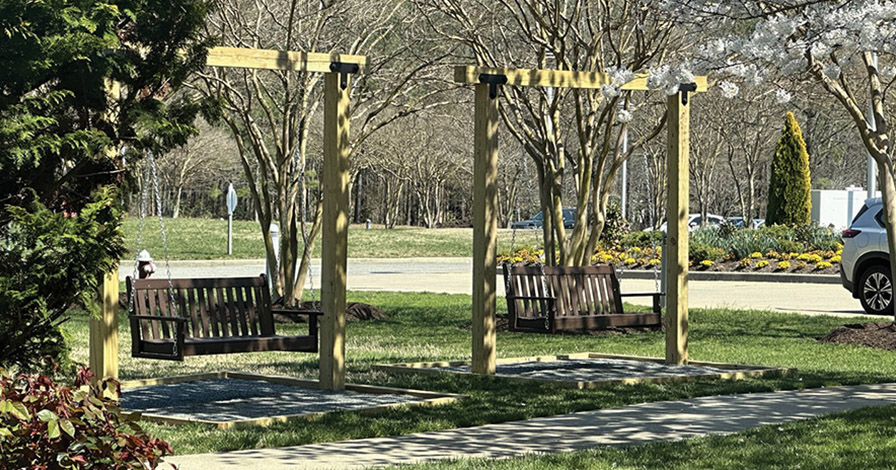
Fortunately, thanks to the generosity of a legacy gift made to the Sentara Foundation by the Shepherd Family, Sentara Williamsburg Regional Medical Center recently became the first certified sensory-inclusive hospital in Virginia. Resources offered as part of this initiative include two sensory rooms designed to provide a quiet, secure, and soothing environment. The hospital also offers sensory bags with noise-canceling headphones, fidget toys, and a feeling thermometer (a visual tool that helps patients measure how they are doing emotionally) that patients can borrow. Outside, two bench swings offer an additional haven.
“I’ve witnessed firsthand patients with sensory needs who were too overwhelmed with the hospital experience to allow our care teams to proceed with important medical evaluation and treatment,” explains Chief Nursing Officer Donna Wilmoth, Chief Nursing Officer for Sentara Williamsburg Regional Medical Center.
Our goal is not only to make everyone feel welcome here, but also to make them at ease enough to receive the important care they’ve come to the hospital for.
This important annual certification, awarded by the Alabama-based KultureCity, requires at least half of the hospital’s 405 staff members to complete training to help them recognize and respond to patients experiencing sensory overload. According to Uma Srivastava, executive director of KultureCity, one in four individuals has sensory needs.
Since earning the certification, Wilmoth shares the impact becoming sensory-inclusive is already having on patients. “Recently, a five-year-old boy came into the hospital, but he was agitated and refusing to be examined. After learning from the boy’s mother that he had autism, staff quickly brought in our mobile sensory station. The swirling fish, bubbles and multi-colored lights calmed the little guy right down and made a complete difference in the care we were able to provide,” Wilmoth continues. “His mother later reached out to me and said she was so appreciative and that we gave her a sense her son was welcome and included.”
Around the world, more than 1,800 locations have been certified as sensory-inclusive by KultureCity, including arenas, airports, zoos, restaurants, libraries, and approximately 120 medical facilities.
“The legacy gift that funded this initiative is having a real and lasting impact on the many patients and families who struggle with sensory needs, but need to receive essential medical care,” explains David Proffitt, Sentara Director of Development and Community Engagement. “We are incredibly grateful to the Shepherd family, who made it possible for the team at Sentara Williamsburg Regional Medical Center to pursue this certification and meet this important community need.”
To learn more about leaving a legacy gift or to receive a FREE brochure, Planning for the Future, please contact us at foundation@sentara.com or 757-455-7976.